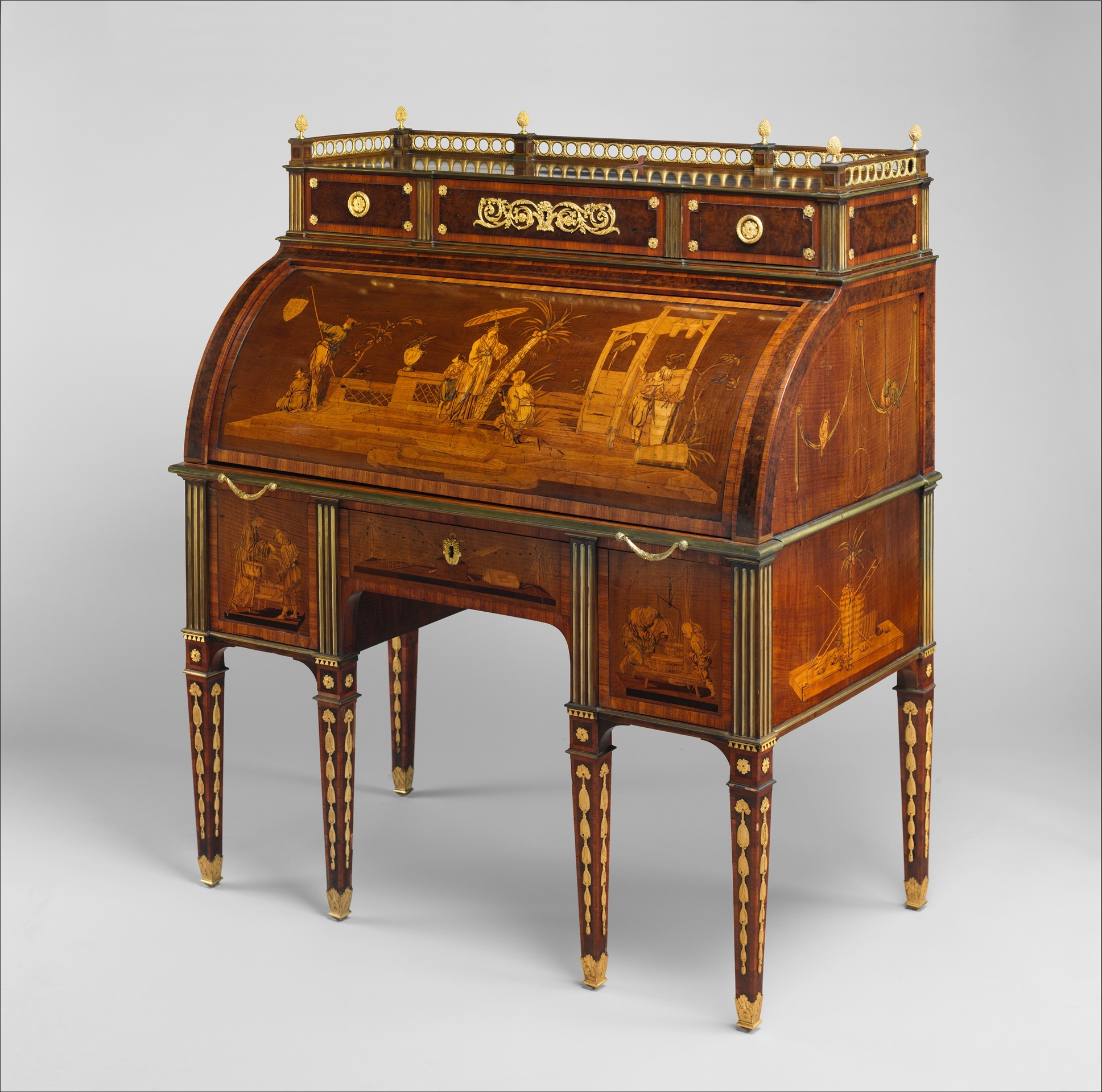
Closed, David Roentgen's desk looks like a piece of furniture designed to be admired from a measured distance. The curved front is covered with inlaid scenes of people, buildings, tools and plants. Gilt mounts impose a strict frame on the imagery, while a low gallery of small pine-cone finials runs across the top. Only when the front rolls away does it become clear that this entire picture field is also a door. [1][2]
The Metropolitan Museum of Art dates the desk to about 1776–79. It stands 135.9 centimetres high, 110.5 centimetres wide and 67.3 centimetres deep. In scale, it is closer to a self-contained cabinet than to the discreet sort of writing desk that disappears against a wall. [1][2]
A working interior behind the picture
With the rolltop closed, the inlaid narrative stretches across the entire curved surface. Open it, and the pictures recede into the furniture as a long writing plane in tooled, partly gilt leather folds forward. Beyond it sits an orderly bank of dark compartments and drawers. The change is emphatic: the exterior tells stories; the interior is arranged for letters, documents and small possessions. [1][2]
It is tempting to call every closed drawer a secret, but the photographs establish something more precise. Roentgen makes movement part of the composition. One object changes between two distinct faces without surrendering its architectural form. The closed rolltop protects the working interior and completes the image; once open, the pictures give way to use.
Wood treated as colour
The museum's materials list is unusually long. Oak, cherry, pine and mahogany appear in the construction. The veneers include maple, burl woods, holly, hornbeam, tulipwood, mahogany and other timbers, several of them partly stained. Mother-of-pearl, leather, gilt bronze, iron, steel and brass complete the inventory. [1][2]
What matters is not simply the quantity of costly material, but the way it is controlled. Pale and dark veneers perform like a painter's tones: skin, clothing, architecture and shadow emerge from the direction and colour of the grain. The Met classifies the imagery as chinoiserie — an eighteenth-century European idea of East Asian forms and scenes. The term describes a European period convention; it should not be mistaken for a precise record of one place or culture.