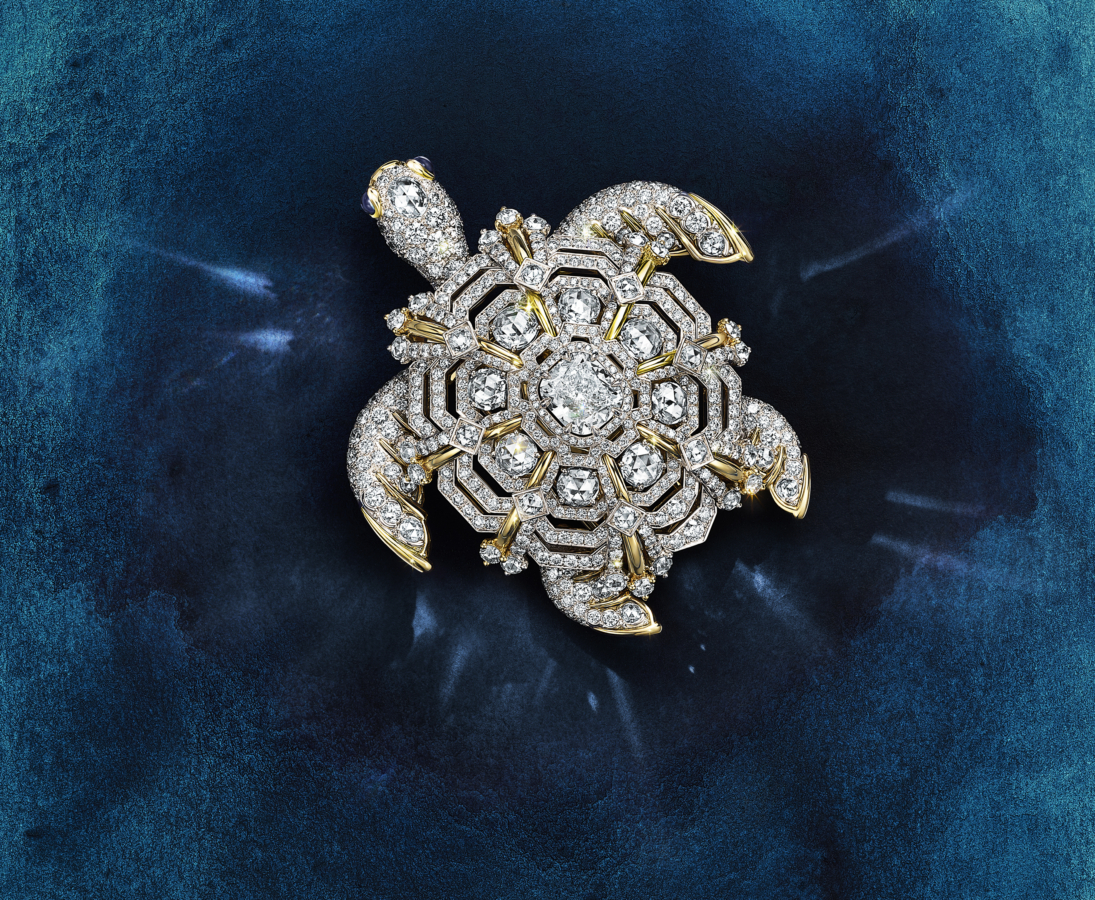
Tiffany & Co.’s Sea Turtle can be worn as a pendant or a brooch. A concealed mechanism makes the change possible, giving this piece from Blue Book 2025 a practical surprise amid the collection’s sea-inspired forms and colours. [1]
Sea of Wonder was developed under Tiffany’s jewellery director Nathalie Verdeille. The collection draws inspiration from organic forms beneath the surface of the sea and spreads them across, among others, turtles, waves, seahorses and underwater flora. [1]
Craft as illusion
In the photographs, the turtle looks almost alive. Tiffany has worked the stones, metal surface and hidden mechanism together so that the jewel can change form without looking mechanical. [1]
The sea as a jewellery language
Other pieces in the series show a different kind of extravagance. Tiffany describes a Wave necklace with more than 17 carats of cuprian elbaite tourmalines. The Ocean Flora necklace uses Zambian emeralds for a more botanical interpretation of the underwater world. [1]
Look closely at the shell and the work becomes clearer. Tiffany describes hand engraving combined with diamond-rich patterns and gold details. The hidden mechanism must also be precise enough to let the jewel change from pendant to brooch without looking like two unrelated pieces joined together. Such craftsmanship is difficult to read in a single press photograph, but it helps explain why this creature became one of the collection's most memorable motifs. [1]
Sea of Wonder is more than an exercise in copying sea life in gemstones. Nathalie Verdeille draws on marine forms to make very different pieces: the green depths of Ocean Flora, the movement of Wave and the almost sculptural shell of Sea Turtle. The turtle is distinctive because it can change its role on the body. As a pendant it hangs freely; as a brooch it becomes part of the surface of a garment. [1]