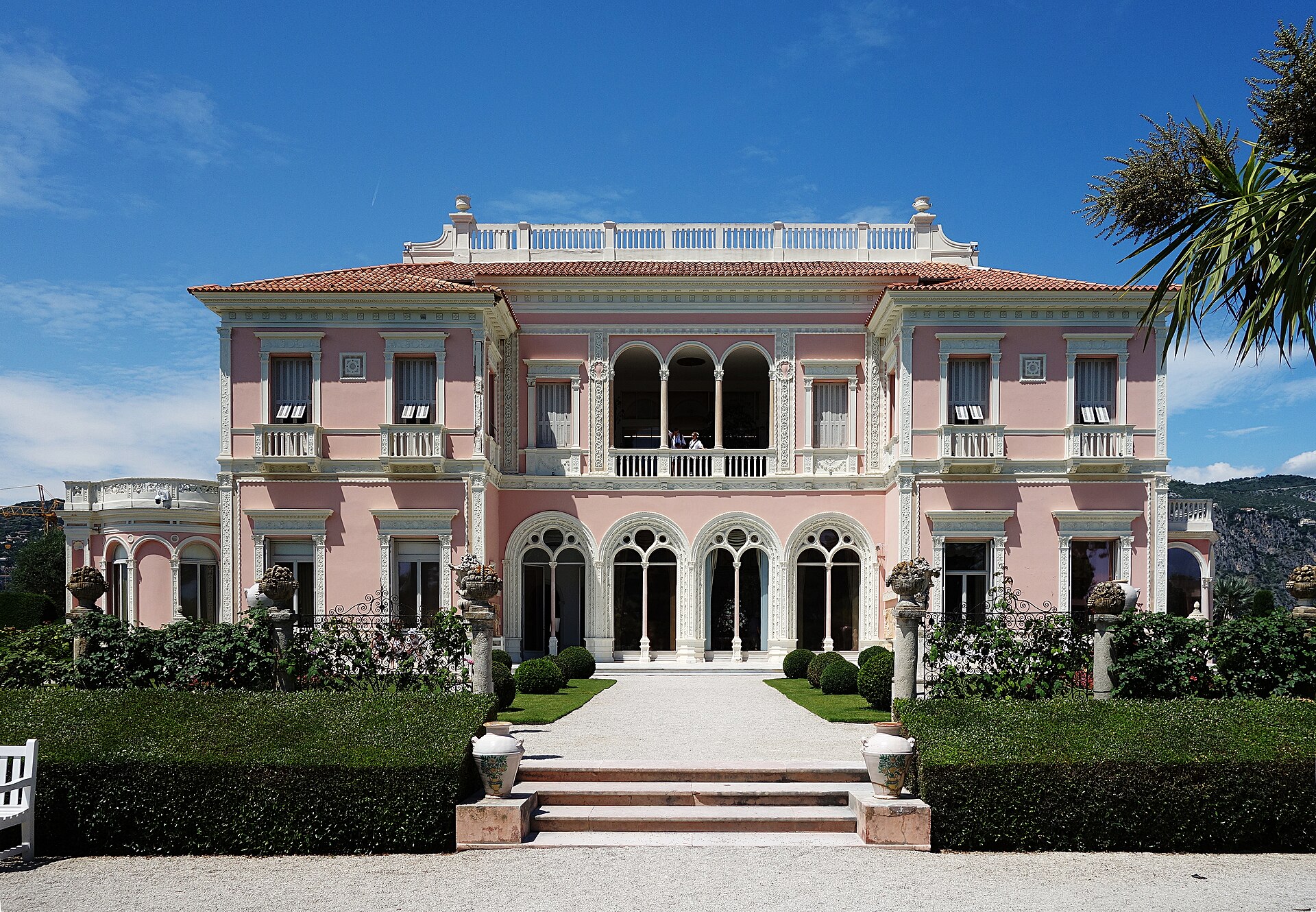
Villa Ephrussi de Rothschild is immediately recognisable by its pink façade, but colour is only the beginning of the story. The house occupies Saint-Jean-Cap-Ferrat between Nice and Monaco, surrounded by the Mediterranean and nine distinct gardens. It is open to visitors today: not a luxury property for sale, but a surviving example of how a great fortune could be shaped into a highly personal world. [1]
A winter house shaped by one owner
Béatrice de Rothschild chose the site in 1905. Building work ran from 1907 to 1912, and the villa became her winter residence. Its official history says that she rejected proposals by two architects before giving the commission to Jacques-Marcel Auburtin. The decision feels entirely in character with the house that followed: this was to reflect its owner’s eye, not a ready-made formula. [2]
The landscape demanded the same determination. A rocky, windswept headland was hardly an obvious place for elaborate gardens. Rock had to be blasted and soil brought in before the grounds could take shape. [2]
A collection made domestic
Inside, Béatrice brought together porcelain, furniture and paintings from different periods. The official account singles out a games table once owned by Marie-Antoinette. Rather than creating a neutral palace of empty ceremonial rooms, she arranged objects with separate histories into a densely furnished home. The blue bedroom offers a particularly intimate glimpse of that taste. [2]
Nine gardens on one headland
The mood changes as one moves around the estate: a formal French garden gives way to Spanish and Florentine references, a Japanese garden and roses. Walking the grounds becomes a journey through Béatrice’s idea of the world, not simply a circuit of a Riviera villa. [1][2]
She later bequeathed the house and its collection to the Académie des Beaux-Arts. Its survival as a place that can still be entered makes this story unusually tangible. Visitors can see how the collection was lived with and how carefully the interiors, gardens and sea were made to answer one another. [1][2]