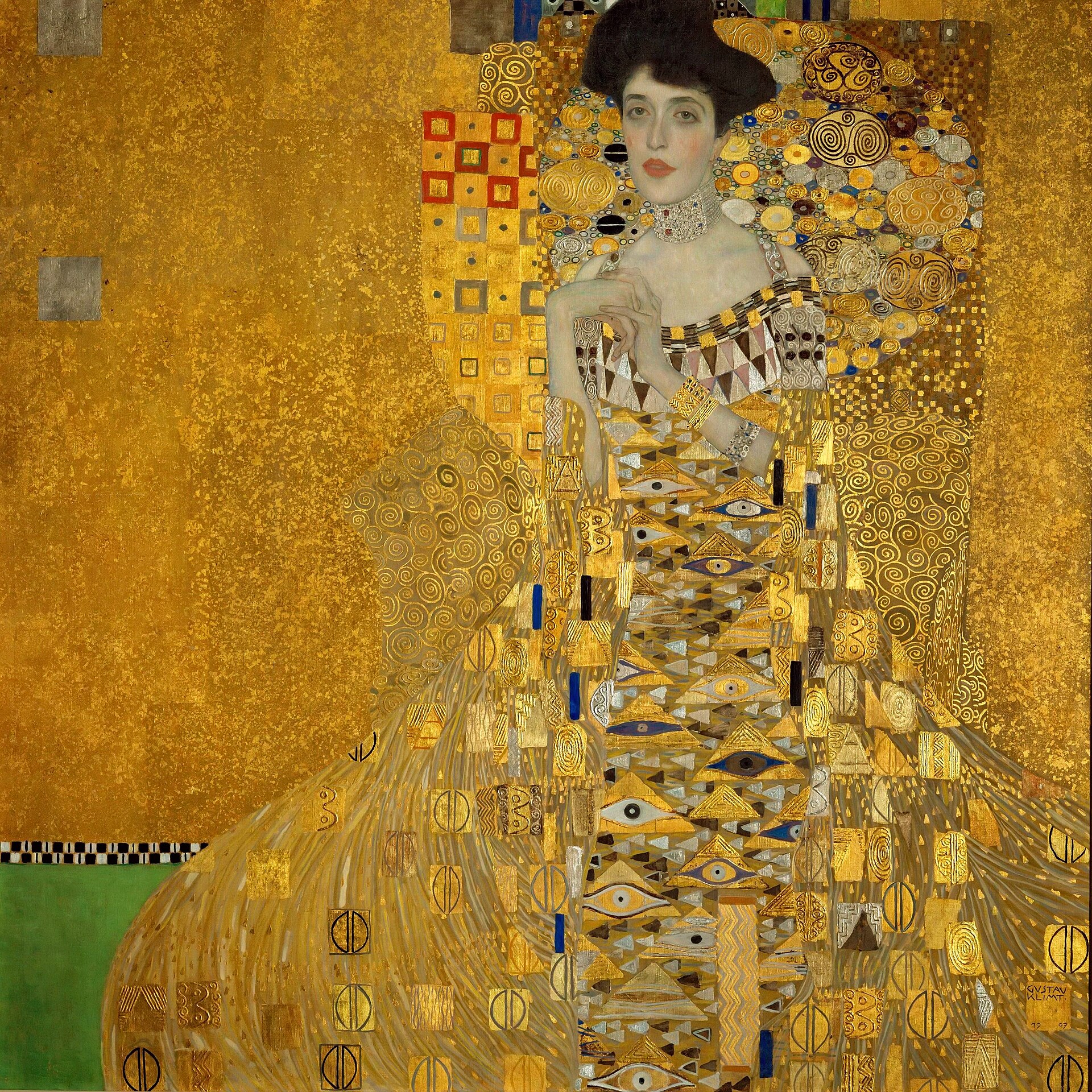
The face occupies only a small part of the picture. Everything else is gold, silver, eyes, triangles, spirals and patterns that almost dissolve Adele Bloch-Bauer's body into the surface around her. Gustav Klimt's 1907 Portrait of Adele Bloch-Bauer I is both a portrait and an entire decorative space. We see a woman, but also a work that makes it difficult to decide where the chair, dress and background begin and end. [1]
Four years from drawing to golden surface
The commission came from Adele's husband, the industrialist Ferdinand Bloch-Bauer, and was initially intended as a wedding-anniversary gift for her parents. Klimt began work in 1903, but did not finish in time. That same year he travelled to Ravenna and saw the mosaics in San Vitale. Neue Galerie points in particular to the image of Empress Theodora as an important inspiration for the portrait's jewel-like fields and layers of gold and silver. [1]
The four-year process can be sensed in the preparatory charcoal drawing. Adele is not yet surrounded by the finished painting's ornament. Her body, the tilt of her head and the hand by her face stand alone on the paper. The difference between drawing and painting shows that the gold is not merely an expensive frame around the subject. It is the construction that transforms a private portrait into one of Klimt's defining works. [1][3]
A face that refuses to disappear
Adele sits or stands in a position deliberately made difficult to read. Her hands are clasped tightly together; according to the museum's account, the gesture concealed a finger about which she was self-conscious. She wears a diamond choker, while eye shapes sit inside golden triangles on her dress. Her initials, AB, recur across the cloak. The ornament is overwhelming, yet her identity is built into it. [1]
Adele occupies a singular place in Klimt's work. She was the only person he painted twice in full length. The second portrait, completed in 1912, is far more colourful and less dominated by metal, but that contrast makes both paintings clearer: the first is not simply an image of a wealthy Viennese woman, but a deliberate experiment in how far portraiture can move towards abstraction without losing the person. [1][2]