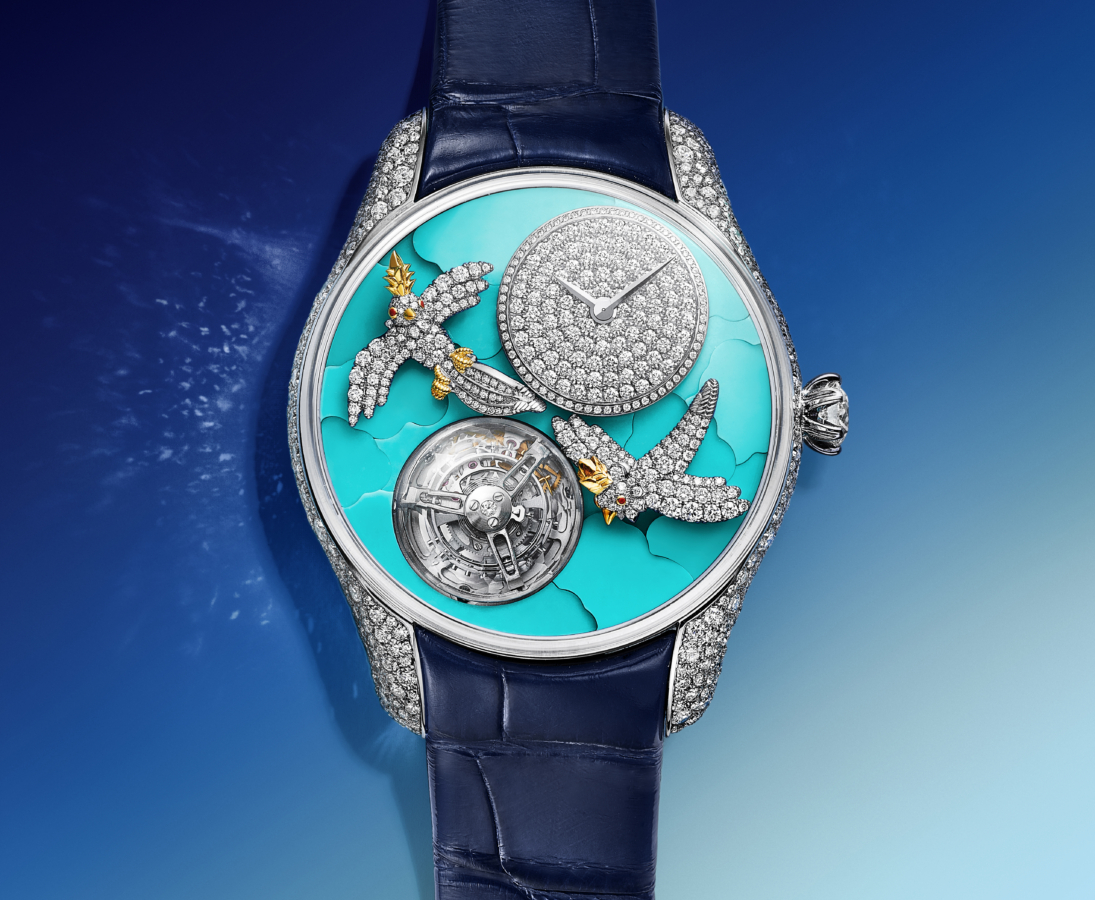
A small bird and 850 diamonds share the wrist. Bird on a Flying Tourbillon is Tiffany’s meeting of jewellery artistry and mechanics: a watch that takes its motif from the well-known Bird on a Rock brooch. According to the manufacturer, the diamonds have a total weight of more than four carats, and the series comprises 25 watches. [1]
The mechanism belongs to the motif
At the centre of the decorative story sits a specially developed flying tourbillon movement. Tiffany describes the model as the house’s first watch with precisely this type of specially developed movement. The mechanics therefore become part of the same composition as the bird motif and diamond setting, rather than being hidden behind a simple dial. [1]
From brooch to watch
The connection to jewellery is deliberate. Jean Schlumberger’s Bird on a Rock was introduced as a brooch in 1965. Tiffany later translated the motif into watches, and in 2024 Bird on a Flying Tourbillon arrived. It is, then, a look back at a distinctive model, not a new launch today. [2]
What is interesting is the scale. A motif first known as a standalone piece of jewellery must now work alongside time display and mechanics in very limited space. The watch is a concrete example of how a jeweller can let its own visual universe shape watch design.
In Tiffany's images, the bird is more than a logo beside the dial. It sits as a small, three-dimensional jewel above the composition, while the diamonds create a bright frame around the visible mechanism. This is a watch to read, but also an object to contemplate as one might a brooch. That double identity links it to Jean Schlumberger's original Bird on a Rock motif. [1][2]
What a flying tourbillon means
A flying tourbillon is a mechanical arrangement in which part of the regulating mechanism turns visibly without the conventional bridge above it. Tiffany says the movement was developed specifically for this watch. Its motion becomes part of the jewellery's appearance rather than something hidden behind the hands. Twenty-five is a small series, but the more compelling feat is finding room for the bird's shape and watchmaking's movement in the same miniature. [1]