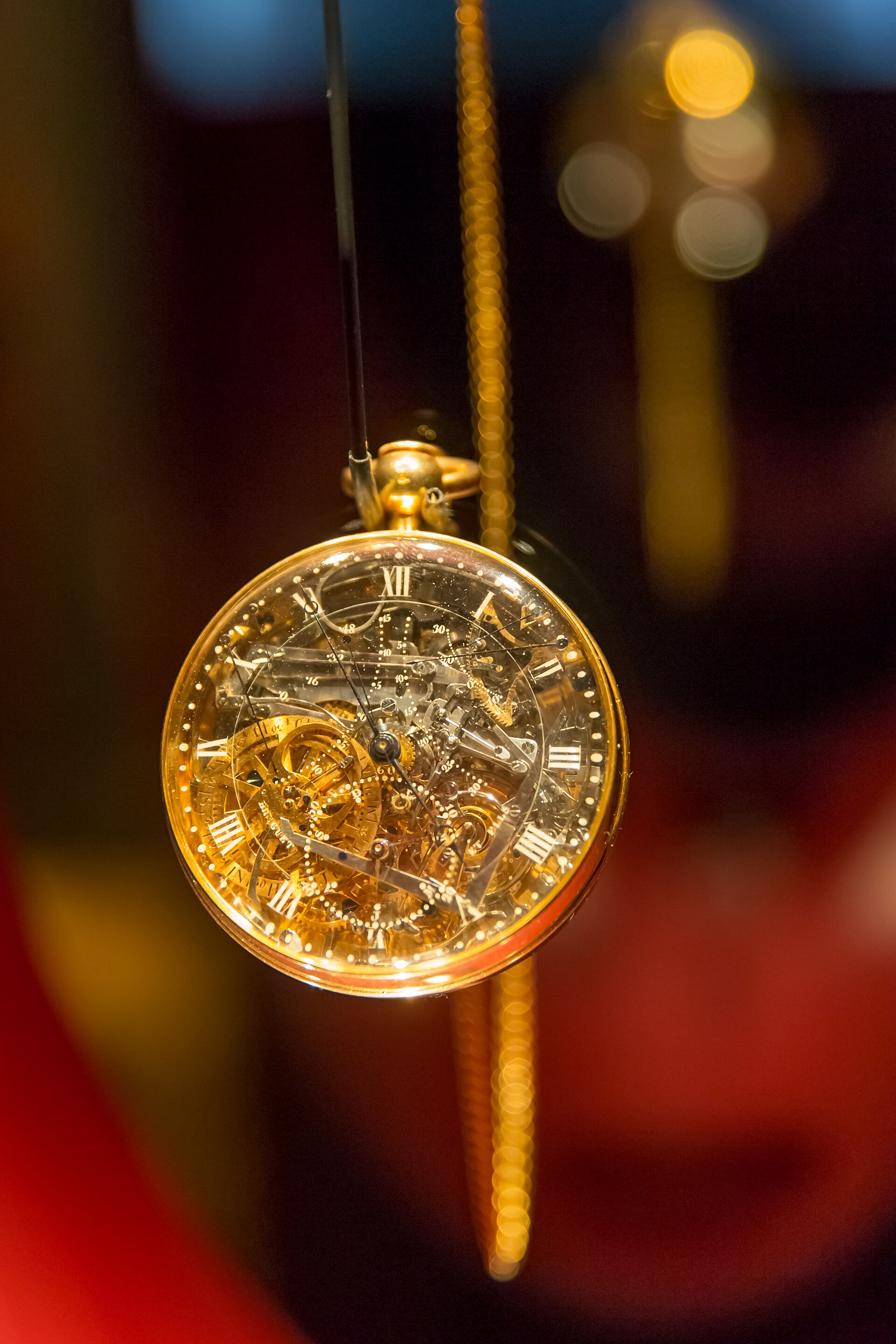
A pocket watch can be so complex that it also becomes a story about time in another sense. Breguet's watch No. 160 was commissioned in 1783 by an officer of Marie-Antoinette's guard. According to the watchmaker's own history, the brief was to bring together the known refinements and functions of the day in one watch, with no fixed limit on time or cost. The queen, an admirer of Abraham-Louis Breguet's work, never saw it completed. [1]
That makes it different from an ordinary royal commission. Its open appearance brings the mechanism forward; the movement can almost be read as a map of watchmaking ambition. Its reputation rests not only on the association with a famous owner, but on the idea of pushing horology as far as contemporary knowledge allowed. Breguet itself describes No. 160 as a watch intended to unite every known improvement and complication. [1]
The story did not end when the watch was finished. Breguet says it was stolen from a Jerusalem museum in 1983 and resurfaced in 2007. The theft gave it an almost mythical status, but its recovery lets us distinguish legend from the physical object. The photograph here shows the historic watch on display; it is not a contemporary model available to order from Breguet. [1]
In 2008, the watchmaker presented a new version based on archival research and original drawings. The two watches should remain distinct: the newer piece is a tribute, while No. 160 is the original with its own long journey. That distinction is part of the fascination. The Marie-Antoinette connection first catches the eye, but the mechanism and the watch's improbable afterlife are what hold our attention. [1]